Increasing Access to Social Benefits
Enabling greater access to the Government of Canada’s social benefits, in particular Old Age Security (OAS) and the Guaranteed Income Supplement (GIS).
Client
Service Canada,
Government of Canada
Design Team
Service Canada Digital Modernization Team
Project Type
User Research, Strategic Design,
HCD Culture Building
The Challenge:
The Government of Canada is undertaking a decade-long digital modernization project for all of the services it offers to Canadians. Currently, all social benefits in Canada are running on a legacy system which has not received investment or upgrading for close to 30 years-- and is dangerously close to failing. In order to address this emergency, a team within Service Canada was created in order to better understand the current needs and behaviours of Canadians who access their benefits program and design a seamless multi-channel service experience.
The Old Age Security (OAS) benefit was amongst the benefits to be identified to undergo the HCD process, and I led the main research study into this benefit to understand the current challenges users faced when trying access their benefits. In addition to OAS, I was also tasked with understanding the particular challenges low-income benefit recipients may have not only accessing their OAS but also the Guaranteed Income Supplement (GIS-- a benefit for seniors below a certain income).
The Outcome:
The insights gathered through extensive user research has lead to a better understanding of the needs of Canadian seniors and their experiences when engaging with Service Canada. These insights fed into the overall design and implementation of a new digital platform for accessing OAS and GIS, as well as a more seamless in-person and phone servic experience. As this was the first HCD process to ever be undertaken by Service Canada, this project allowed for trust in the design process to be built.
The Approach:
This project took on a multiple-pronged approach. An initial analysis of all previous research done in the OAS space and consolidating all the insights it into one meta-report. One-on-one interviews with frontline staff to better understand how the pandemic has impacted seniors’ needs and behaviours. And finally, in a series of workshops with Service Canada and Ministry staff a OAS service blueprint was co-created.
In addition to the OAS user research conducted, HCD culture building through education hours, in which we explained to staff about the HCD process and best practices.
Project Methodology
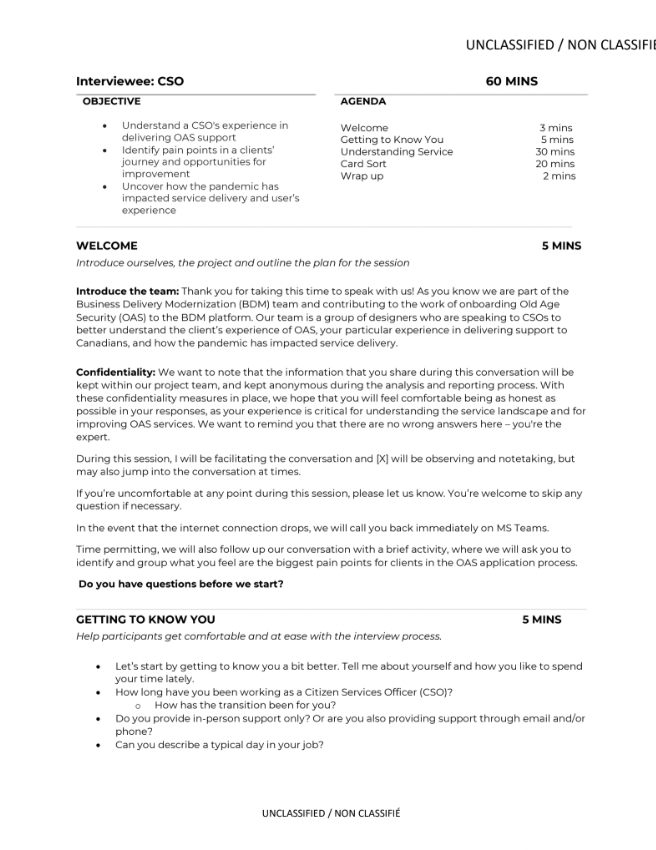
In-Depth Interviews
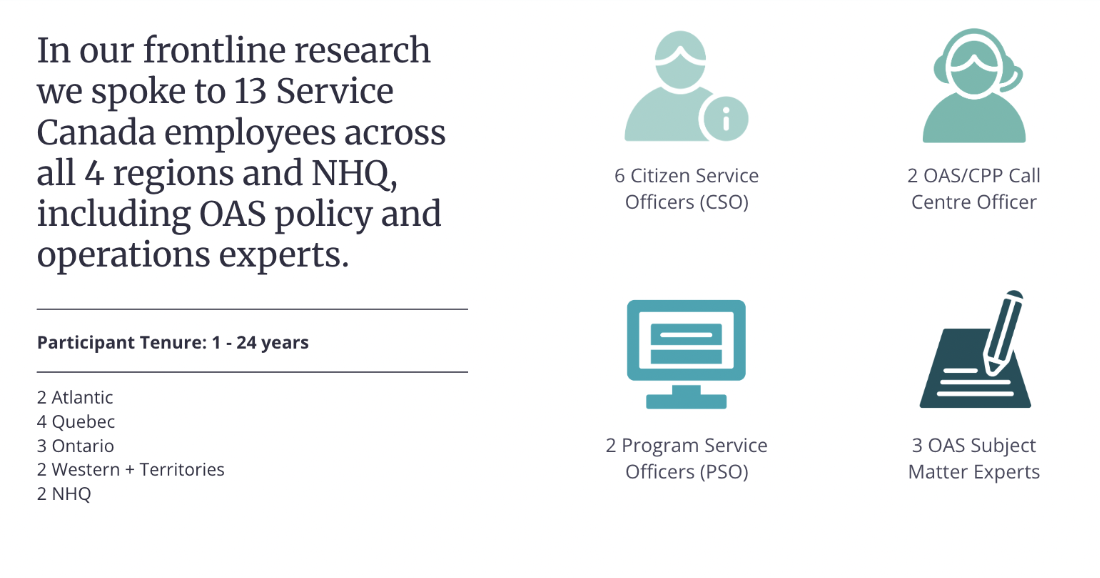
The aim of the interview was to uncover the pandemic’s impact on frontline staffs’ delivery of services, policy and procedures, and seniors’ experiences with OAS and income-tested benefits.
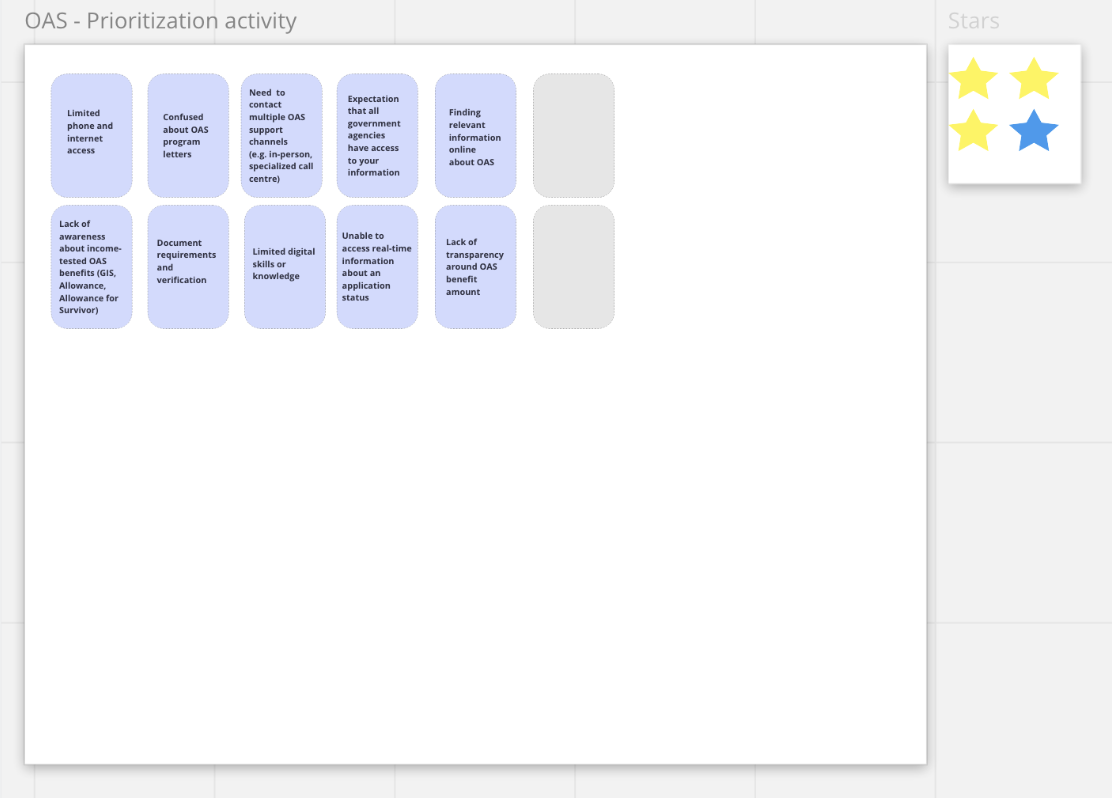
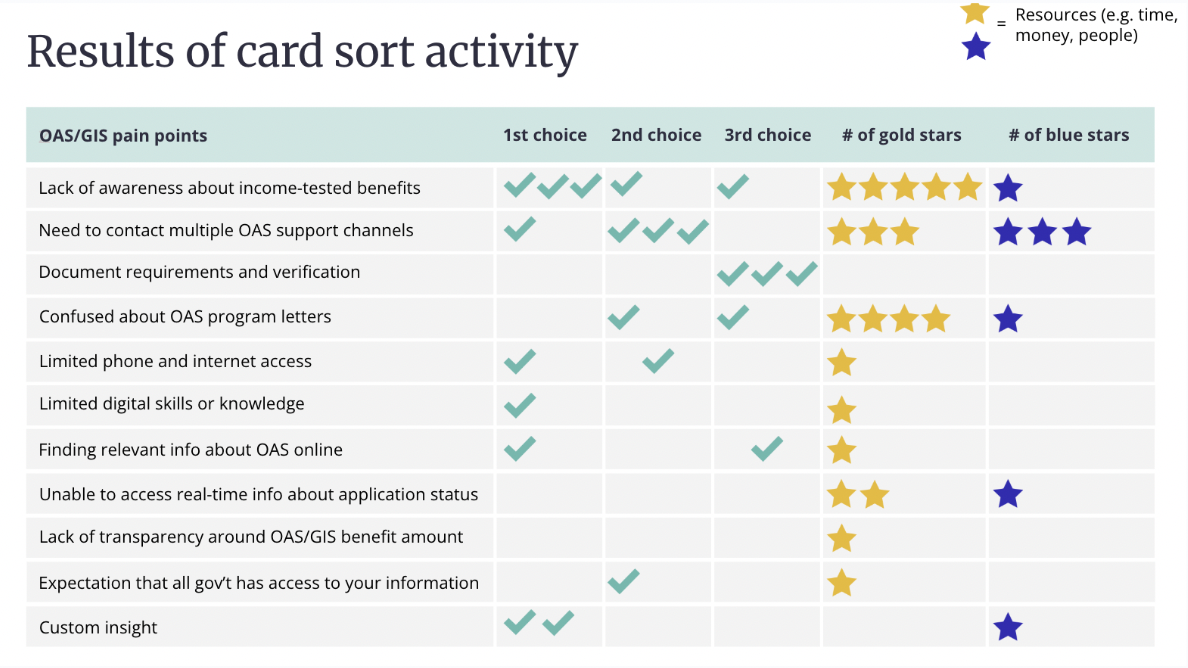
Card Sort
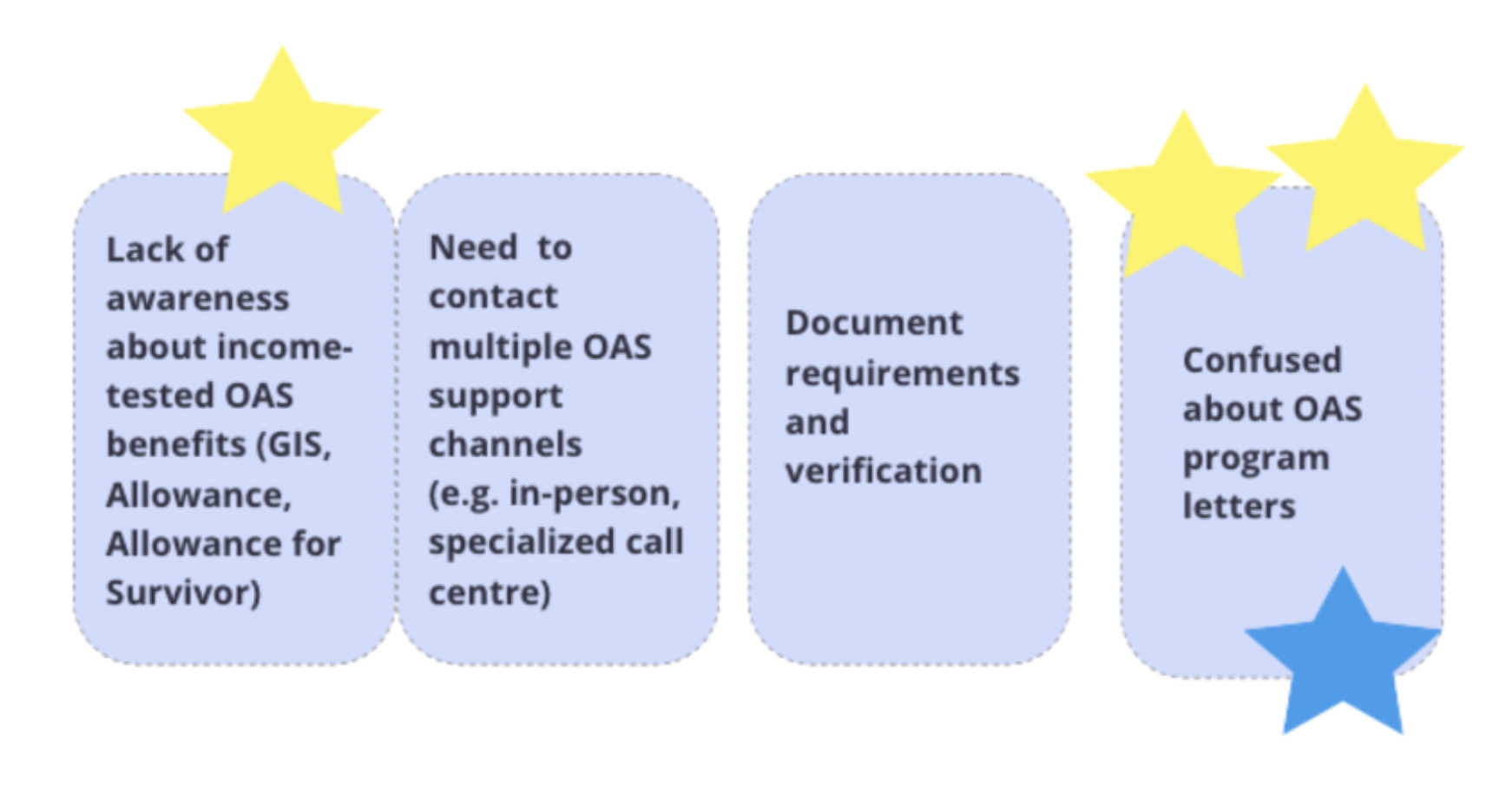
Participants sort and reorganize a set of virtual cards using Miro Board. The cards included a variety of pain points that we’d uncovered through secondary research. Participants were asked to sort each pain point from the most common to the least, and then identify which pain point they’d like to see resources devoted towards solving.
Co-Creation Workshop
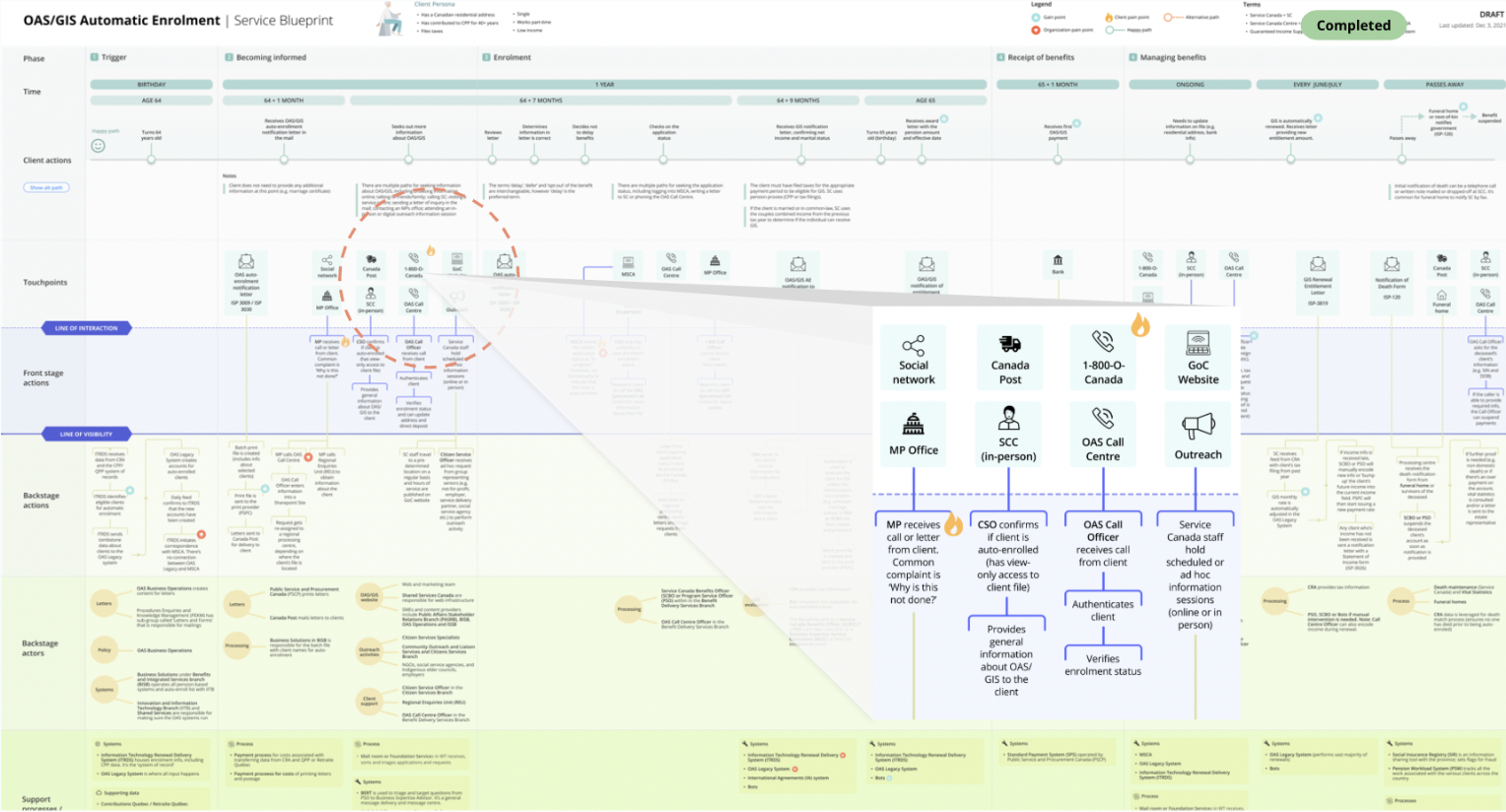
Subject matter experts (SMEs) from across Service Canada were brought together to create a service blueprint which helped to generate a baseline knowledge of the end to end service processes, pinpoint dependencies between client-facing and internal support processes, and finally identify pain points (what can be improved/optimized) and gain points (what's working well) for both the client and organization.
Reporting
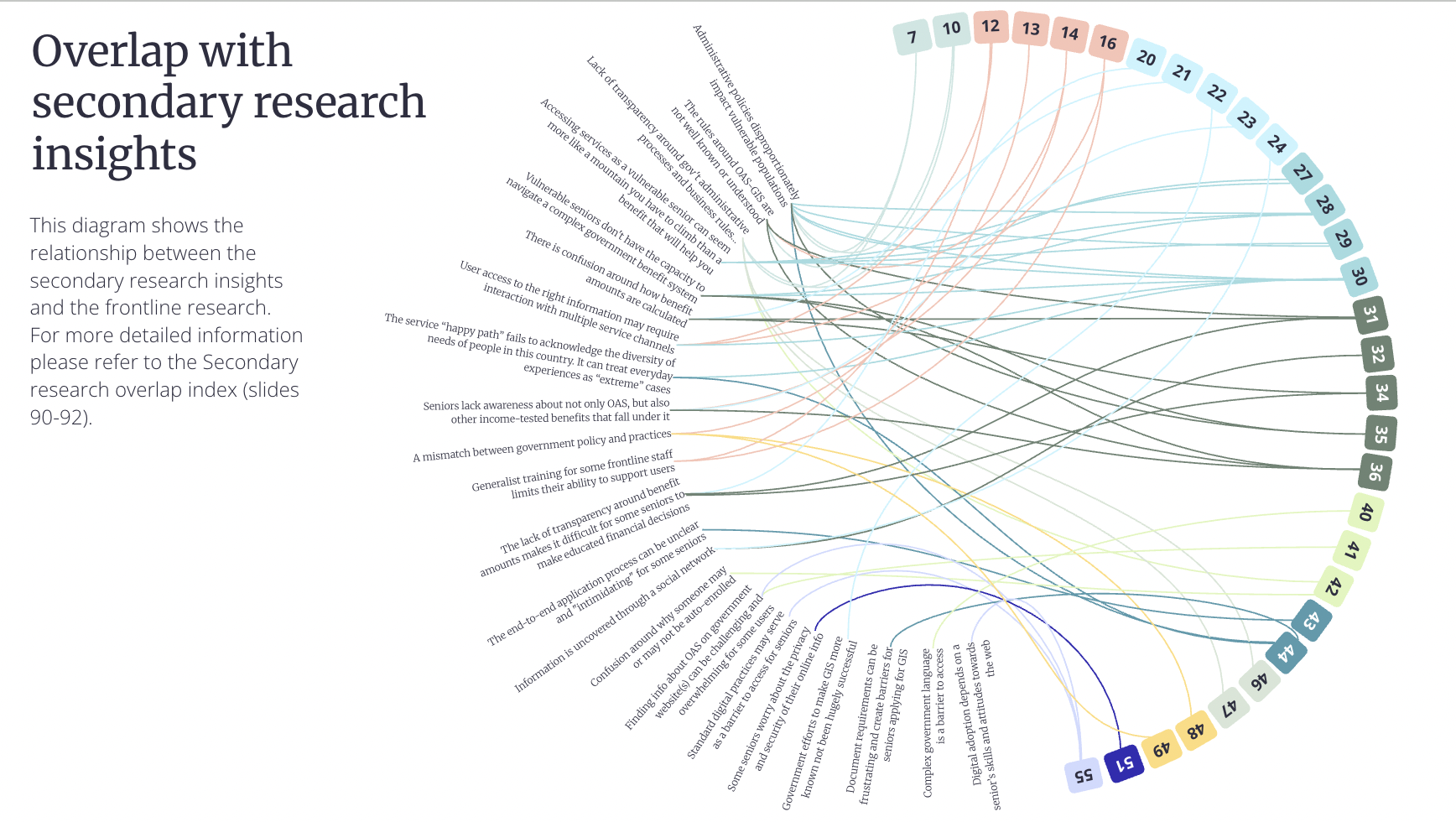
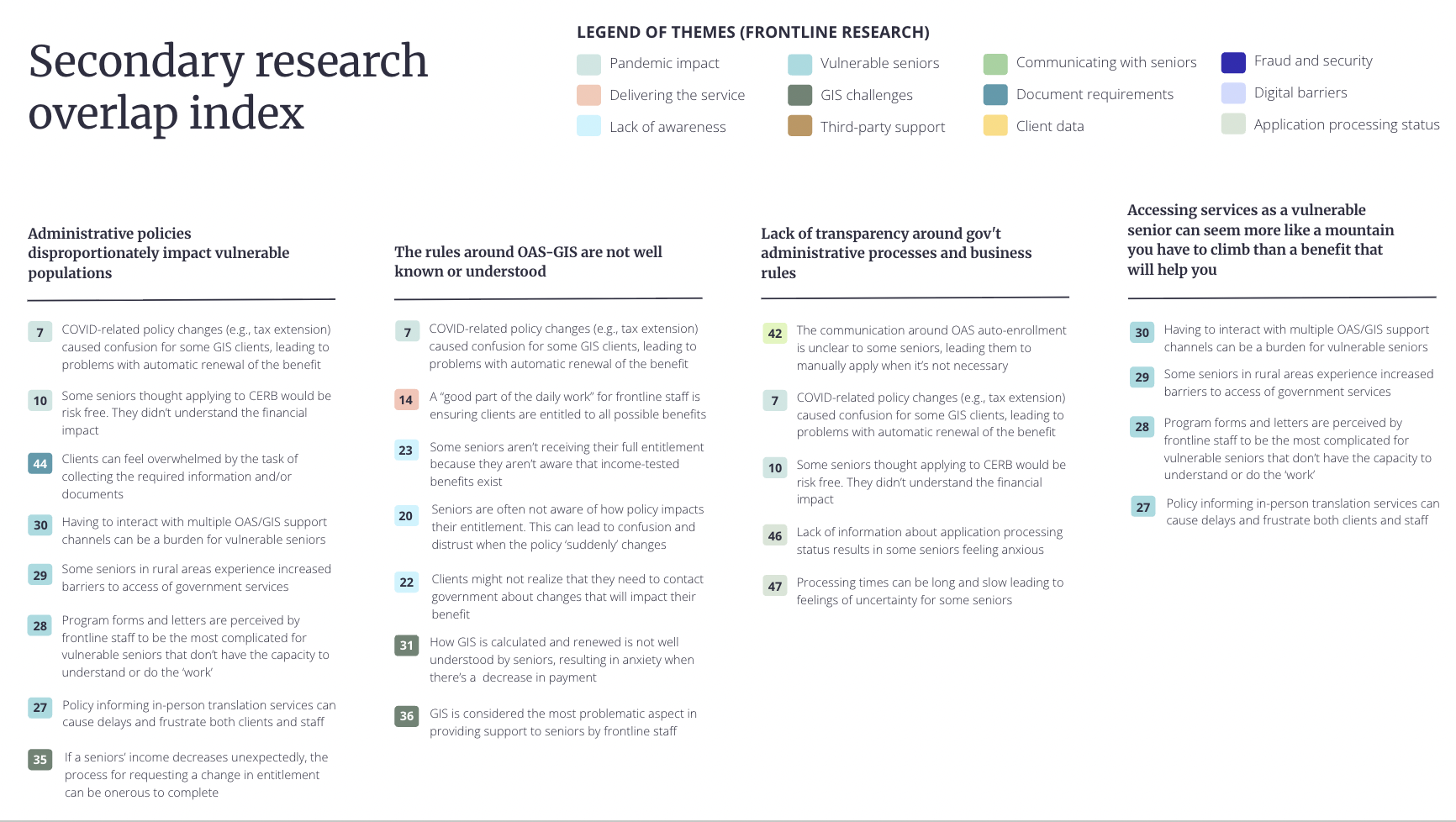
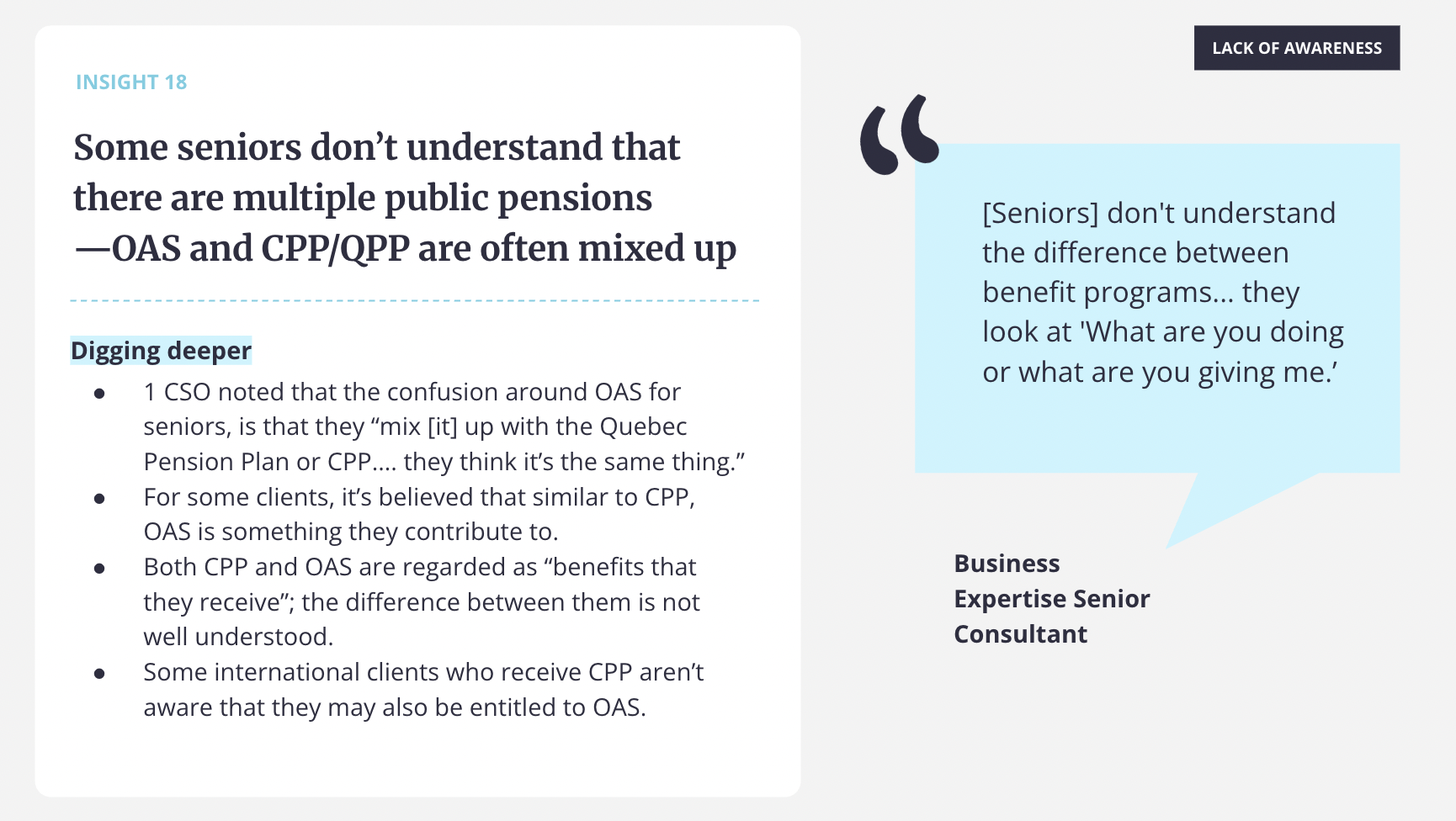
After compiling all the previous research, conducting in-depth interviews with frontline staff and Canadian seniors, and creating a current state service blueprint, some insights emerged, including:
Administrative policies disproportionately impact vulnerable populations, namely low-income seniors who face increased hurdles and more administrative procedures just to access the benefits they require
The rules around OAS-GIS are not well-known or understood by the majority of Canadian seniors
Lack of transparency around government administrative processes and business rules is not just limited to applying but felt throughout the “benefit lifecycle.”
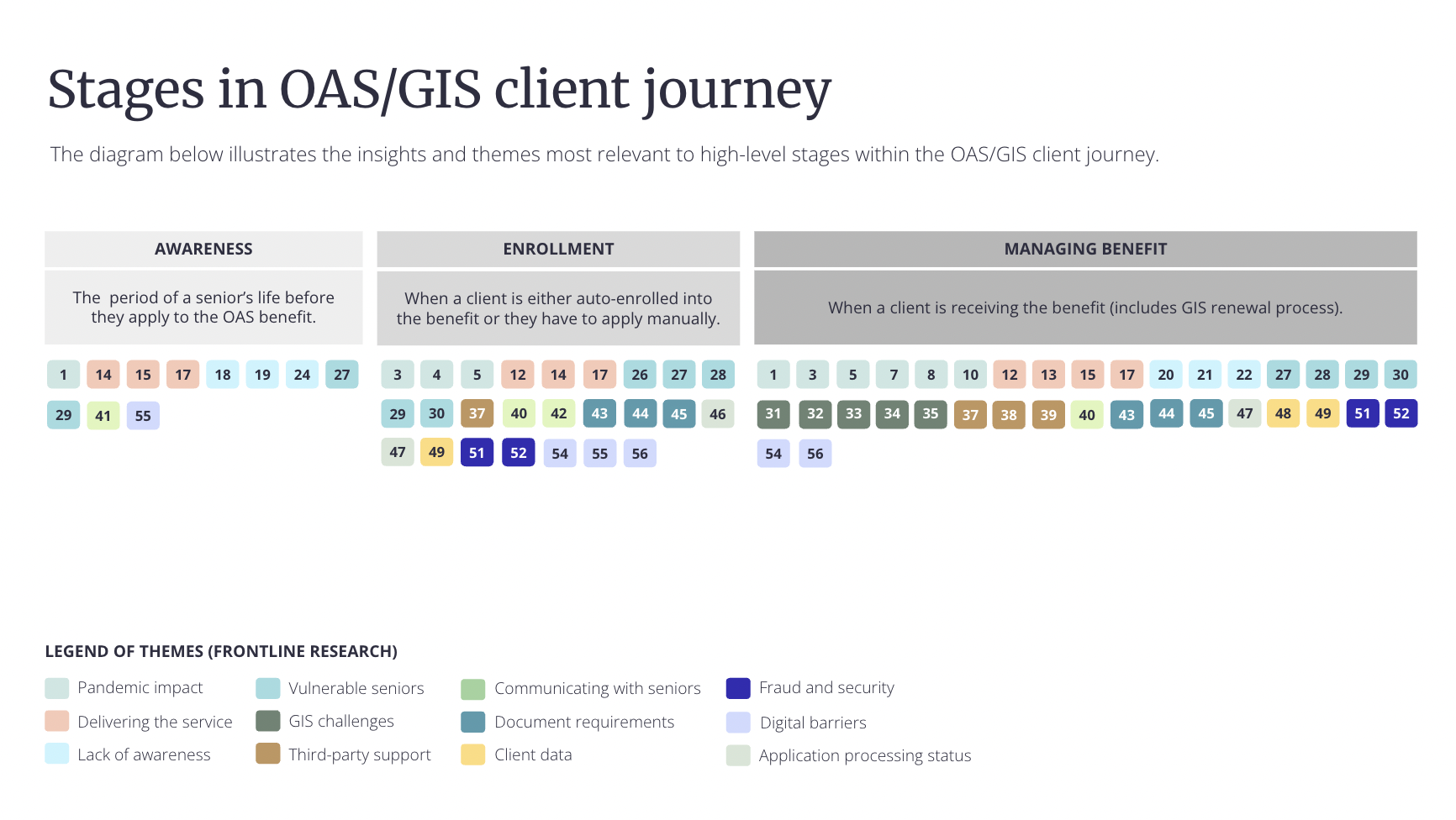
These insights and the service blueprint helped to provide a baseline knowledge of the current state of the end-to-end journey for Old Age Security benefits and GIS. It also the identified areas of opportunity provide a roadmap of future work for the Service Design Digital Modernization team